Showing posts with label Marine biology. Show all posts

Sunday, December 4, 2011

A trip down to the sewers!


25th ICCB: Marine Think Tank
Third Day of the Conference – Dec. 4th
Start
            Not going into it.  Did a bit of volunteering and moving onto the session.

Session
            Got started at 9 AM with a round robin of introductions – lots of marine mammal big names.  Kind of humbling to meet the faces behind the names of the papers I have been referencing and studying for the past few years.  Like being in Hollywood and see all the big stars for me.  So I am totally star-struck right now.  Our hosts are Liz Slooten and Steve Dawson – resident experts on Hector’s dolphins and various other marine mammals.  The goal of the session is to get conservation science listed under conservation management.  Yeah, I have no idea either but apparently it is a big issue.  Going to learn lots about it in the coming hours.
            Aside: pet peeve = soft-spoken speakers.
            While the session began with a background on by-catch and Hector’s dolphins serving as case studies, it quickly degenerated to discussion on enforcement, political complaints, and funding issues.  Those first two are common topics of conservation at the conference and have arisen in every discussion I have participated in or listened to without fail so far and I doubt very much that will change.  Like the USA, the New Zealand government is scaling back funding, especially on the conservation side.  In the USA, I am not surprised as science and education are always the first things to go right after social welfare, but as New Zealand’s prime money-maker is eco-tourism I am kind of surprised.  The whale watching business alone makes millions of dollars, much more than the fishing industry.  Apparently one of the prime ministers of New Zealand simply does not have an environmental bent, and as I have been told, well, the next election is in three years and you can bet that without major turnaround someone is more than likely going to be out of office.  Conservation means you have an ecosystem to show tourists and the major money-spender right now in the travel business is the self-styled eco-tourist, so no conservation means no ecosystem and you can do the rest from there.
            Back to the session however, the background information on Hector’s dolphins was good to hear for my research paper due in oh two days.  My population ecology class asks for a 2500 word paper which I have chosen to write on the Hector’s and Maui’s dolphins of New Zealand.  Have an abiding love for this country and its dolphins.  The discussion however just served to demonstrate just how out of touch some scientists are with social science, psychology, and social networking.  I don’t claim to be an expert by any means but some of the conclusions reached during the session are things I was taught in leadership training throughout high school and college.  A plan of action, goal, follow-though, and then revisiting your work to judge your success are all basics for project planning.  Communication is essential between all group members and those involved in the decision-making process, however if you have power to enforce your decision and you cannot get certain parties to compromise then don’t, just tell them the plan and that this is it.  I do recognize however that theoretical training and planning is much harder to put into practice.  And yet, this session seemed to still be grasping just the theoretical concepts and not discussing issues that had been run into while implementing them. 
            Social networking is vital to any scientist.  If you want to be reaching out to the non-scientific community then you should be summarizing your findings in a blog, have a twitter account, and be running a facebook group among other things.  The man behind WhySharksMatter offered some great advice and free help on all of this.  I really hope session members take advantage of his offer; I know I will be in terms of creating a website and posting an article or two on Southern Fried Science. 
            Aside: running between buildings in the pouring rain (thank-you 4 seasons NZ) for every lunch break, tea session, etc. is not fun.  Feel bad for whoever wore white – looking at you my fellow volunteers.
            The session ended on a good note with summarization of how to properly implement a plan of action for a critically endangered species and how to approach government officials to get your voice heard.   Simple stuff such as publishing in articles read by the government and making sure to voice a rebuttle to those with an un-informed opinion or voicing data you know to be wrong are all steps to be taken.  Also, a good reputation is nice to have, but almost all of the conservationists you can name which got any protection for her or his cause were not respected at large by the scientific community and were extremists, but you know what?  They usually got significant protection and work done for their species.  Not saying it is necessarily the right way to go about it, but you should step up and say something to defend what you know is right instead of backing down at times.  Everything in moderation, right?
         
Evening Activity   
           Enough with the dreary talk, at the end of the session we had a bit of downtime before heading over to Kelley Tarlton’s marine aquarium built in the sewer.  Very awesome place which served as the inspiration for my group’s section of the Ugly Zoo class project this semester in Endangered Species – coolest project ever! Dr. Parsons rocks!  Went over to the session via cab, not too bad in cost, and manned the door for a bit before checking out the penguin ride.  
The ride takes you through the Antarctic section of the building and specifically through the penguin enclosure where they have two species of penguin.  Coolest thing was the baby penguin chicks J Glad I wasn’t able to smell them though.
The main reception area with food and drink was next to the miniature pool housing fish and giant rays.  Those things are massive!  A comment on the food – sea food at a marine conservation lecture, really?
            Headed down to the sewer section of the building to grab some video for my group project, and it was as cool as ever!  I have been to the KT aquarium several times and always enjoy my visits.  Got to see a sea turtle and numerous native fish, also about 7 species of shark. 

            Spent the rest of the session geeking out, talking, and then catching a cab back to O’Rourke Hall to sleep.  Thanks the gods I have a NZ cell, quite a few people were left without a way to get back because no arrangements were made for transportation.  Our cab driver called in a request to have more cabs sent over thankfully for everyone still there.  Unfortunately, the photo card I took the photos on has been lost and I am not sure I will find it before the end of the trip.  

Saturday, December 3, 2011

Out of this world, once in a lifetime experience!

25th ICCB 3rd Day Afternoon Activity: Whale Watching
Afternoon Activity
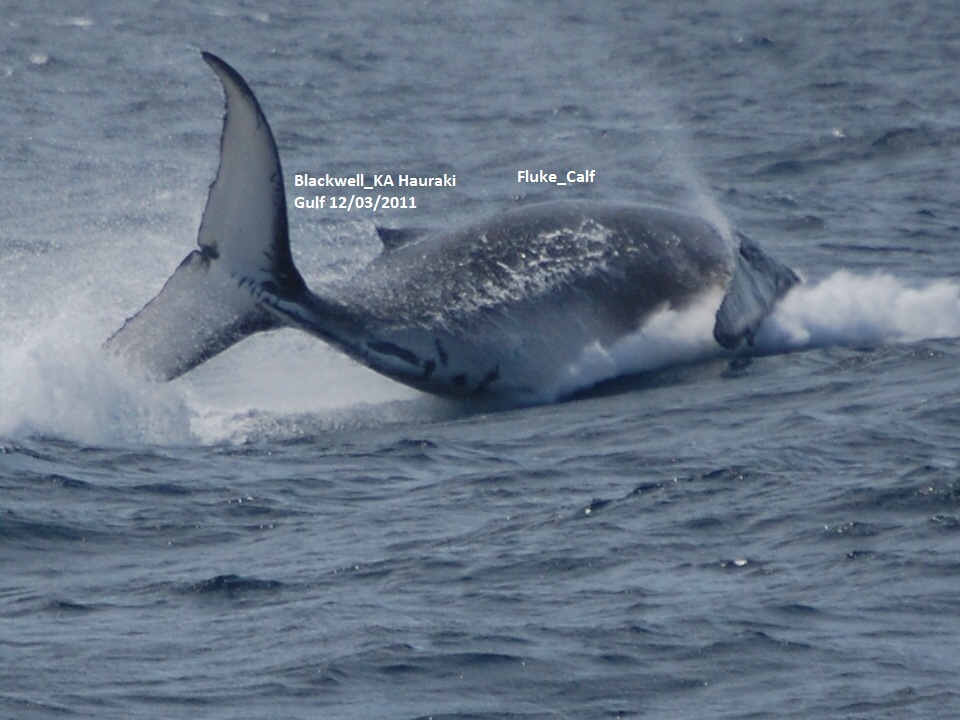
            I elected to go out on the Auckland Whale and Dolphin Watch rather than attend the afternoon portion of the conference.  Turned out to be the best decision I could have made – not only did I see Common Dolphins and at least 5-7 Bryde’s whales, but there was a mother-calf Humpback whale pair!  Now, I know you’re thinking – Humpback whales, really?  I am serious though!  Location is a huge deal for this species!  There have only been two sightings of this species in the Hauraki Gulf since 1960 according to the boat captain and marine biologist on board.  Humpbacks are NEVER seen in this area of the New Zealand.  Don’t get me wrong, I was much more excited by the Common dolphins and glad to have seen the Bryde’s whale, but the Humpback pair were going through the social interaction routine.  We saw flipper slapping, breaching (body, tail, head, full), twisting, ½ tail in the air, and so many more behaviours with baby copying Mom every step of the way.  An amazing, amazing experience!


MPA's and OMG Whales!

25th ICCB: Marine Think Tank

Second Day of the Conference – Dec. 3rd
Start
            Got up at 5:30 AM today, friggin jet lag and rap music by my early rising neighbor next door.  Headed out to the conference at 8:00 AM and acted as a runner by guiding people to rooms, which resulted in me getting to my conference about thirty minutes late.

Session: Pelagic Ecosystems and MPA Management
My session group
            Mostly just conjecture today for the most part.  We have a specific MPA we’re looking to create and plan for – 100,000 km2, no-take, remote, and an oceanic/pelagic ecosystem – with the objective of maintaining the natural value of the area.  To start, we identified the major threat to the area as fishing.  To combat this threat we needed to track regional information on fisheries such as shark fishing and track users.  In addition, a baseline needs to be set to establish site characterization and monitor changes from the baseline; this process would be aided by a historical baseline.  Key habitats and species should be identified as well as biodiversity levels and ecosystems types within the reserve. 
Once the background information has been established, that’s when you start coming up with an action plan for your endangered species, vital ecosystems, how to protect key areas, combat threats, and work to involve the community and gain the trust of the fishermen so that the project will be maintained after the managers leave.  You will leave sites eventually, it is only the rare obsessed scientist that adopts a site and makes it home permanently and they get added to the “Experts Hall,” meaning they have no life outside of that site.
            Need to make sure that there is continual surveys and scientific information coming in from this site.  Also, when conservation measures are taken, you MUST follow-up and see what resulting changes have taken place from the new rules.  One way to keep this up is through existing efforts, getting various interest groups involved, get the locals to monitor it, attach the project to a university department, and set-up a volunteer program for fledging marine biologists.  Hey!  You need experience when you’re first getting started.  You will get to travel and go to sites unvisited by the general public, but you’ll pay to do it and have only the basic necessities, if that sometimes. 
            If marine mammals are present, then it would be good idea to detect sound and somehow deter speedesters from potentially running over the dolphins.  Marine mammals can serve as measures as to how well the marine reserve conservation are work as the return and increase of apex predators is an indication of a healthy ecosystem.  Benefits may also be quantified through improved species population levels, biodiversity, size and catch of key species, etc. but all of these measures must be tempered by a realistic timeframe.  This can be made easier with specific control sites for comparison.  Essentially, there is a lot of detailed information that must be considered when designing and implementing an MPA, no matter what type it is.  You can benefit from talking with people who work on MPAs and general research, but the only true way to know what you’re dealing with is to be able to handle any issues that will arise and carry on with the project.  The ocean is an unknown variable even in the simplest of experiments and an MPA means trying to account for every variable in that section of the ocean.  Best you can do is to come up with a basic plan and be ready to MacGyver your way through.
           Aside, when attempting to plug in my computer to the adapter socket I got a nice electric shock, my first actually.  It hurts!  My teeth hurt!  My finger hurts!  Never ever want to know what lightening feels like.
            In terms of enforcing the rules of the MPA, you’re going to have to factor in things like cost (money isn’t going to be found on the sea floor in sunken ships) and what you’re exactly going to enforce.  You’ll need you to establish channels of communication and make sure the community supports the enforcement otherwise you won’t get anywhere.  Locals’ support is the single greatest thing you will need to ensure having for a MPA to work.  Vessel monitoring is also an expensive alternative but it allows you know the location of every boat and its activity. 

Afternoon Activity

Auckland City
            I elected to go out on the Auckland Whale and Dolphin Watch rather than attend the afternoon portion of the conference.  Saw not only Common Dolphins and at least 5-7 Bryde’s whales, but there was a mother-calf Humpback whale pair!  We saw flipper slapping, breaching (body, tail, head, full), twisting, ½ tail in the air, and so many more behaviors with baby copying Mom every step of the way.  There is a more detailed posting with pictures.


  The Common dolphins were tiny, angular, and adorable and the best bow riders ever!  So I am gushing, deal.  I got into this field because I love what I am studying, the knowledge and science are both just icing on top of a strawberry angle cake.  Commons were amazing to watch, they followed and swam in the wake of the boat for over 20 minutes.  


 Bryde’s whales acted pretty similar to the Sei whale I watched on in Mass. but it did display open mouth feeding and lunged up with a gaping mouth full of fish.  Very nice, no pics though.  


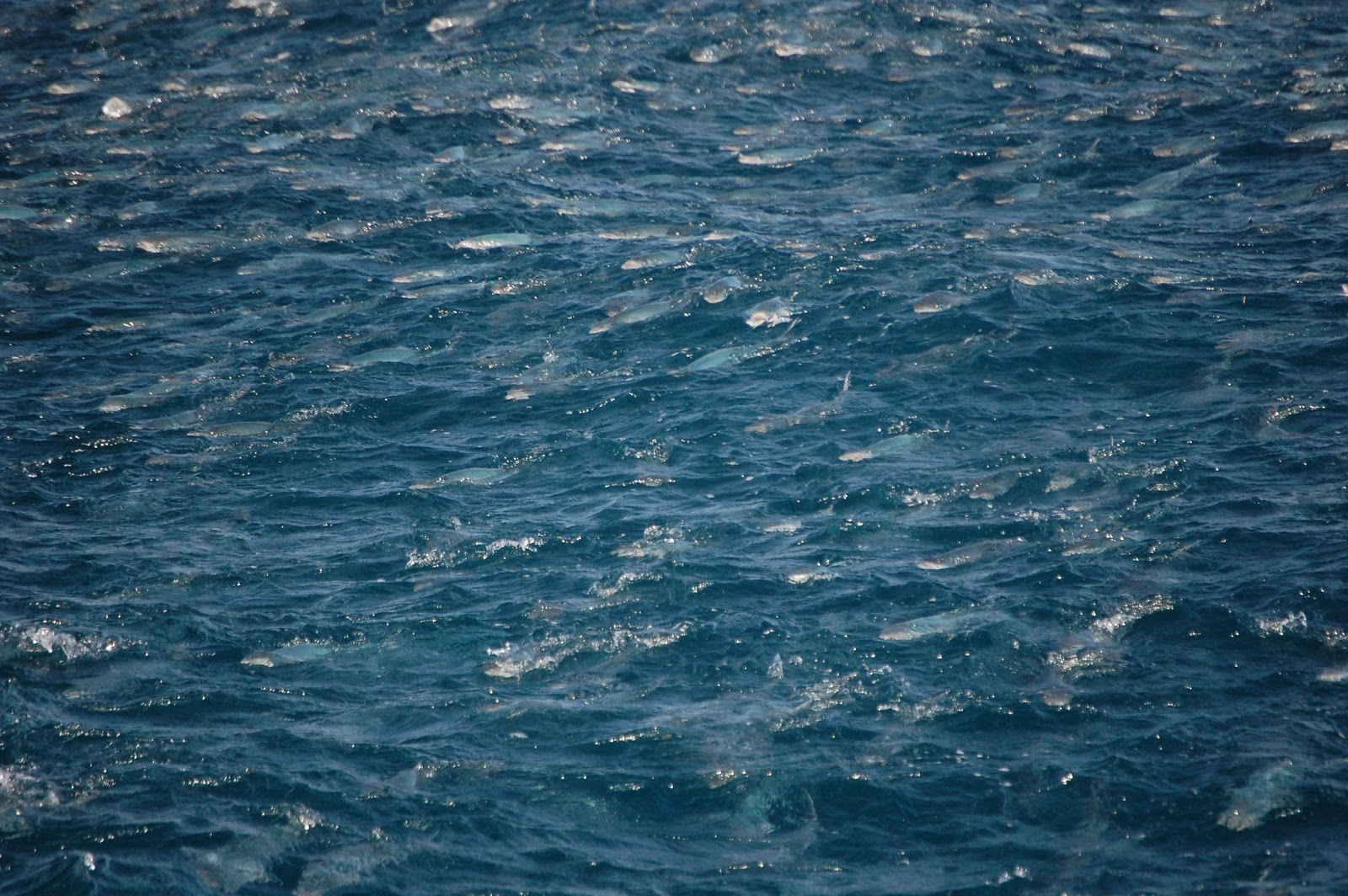
 We also got to check out some bait balls or roll-ups, where schools of fish are driven to the surface by predators.  Sea birds were going nuts dive bombing these poor fish!


           The marine mammals were all sighted by tracking associated sea birds that follow the whales and cetaceans to find food.  Awesome and very interesting technique.  Just goes to show you that you need to get out and travel because you learn so many different things in different parts of the world.  Everyone does the same things differently and what works one place may not work elsewhere but then again it may and you would never know until you try.  Lost my sunglasses as well which wasn't too great.
            On whale watching, questions never to ask that are asked without fail every time:
·       Where is the place to see dolphins on the boat?
o   Anywhere, sit anywhere.  Just not inside.
·       Can I feed the dolphins?
o   No, no, no, no.  Even if they say yes, still no!
·       Can I pet the dolphins?
o   Sure if you want a disease or to get bitten.  No!
Questions to ask:
·       What types of marine mammals will I see today?
·       What kind of fish do they eat?
·       What is the sea state today?
Best advice I can give you: take sea sickness medication before you get on a boat even if you never get sick, especially if you have never been on a boat or are from Asia – not trying to be racist because without fail on every trip I have worked on or been on those from India, Japan, China, Korea, etc. have always gotten sick.  Save yourself and the crew the misery and just take the ginger tablet so you can enjoy your trip and your poor naturalist isn’t cleaning up puke. 

Evening
            Well, I rushed back in wet shorts (ugh) to put everything online because I was so excited.  Took hours!  Oh well.  Got a text from a friend to meet-up and go out dancing.  Was wide awake from all of the excitement so I freshened up and headed out.  Got to see the new convention center for the Rugby world cup, the new downtown on water, the X-mas display, and much more.  The X-mas display has tons of beanbags at its base where you can crash and relax all evening – so cool!  No way would it happen in the States, it would be destroyed.  Hit up four different clubs ranging from hip-hop to techno, very good range and a nice walk.  But man, Auckland wakes up at night!  People just get started at midnight, I was beat at 11 PM but it was a nice change of pace and to see another face of the city.  Headed to bed after a good night of dancing on the waterfront.